Why this race exists
The Walt Disney World Marathon was Disney's response to a simple question: what do you do with a theme park empire that closes at midnight and reopens at 9 a.m.? Run a marathon through it before the gates open.
The race was conceived in 1993 by then-Disney Sports executive George Kalogridis and longtime running journalist Joe Henderson, who pitched Disney leadership on a January marathon that would route runners through Magic Kingdom in the pre-dawn dark — a closed-park experience no tourist could buy.
Disney leadership said yes. The inaugural race went off on January 9, 1994 at 5 a.m. — the earliest start time in major US marathon racing — with 8,015 starters and 7,256 finishers (a finish rate that would be considered exceptional today).
The five eras
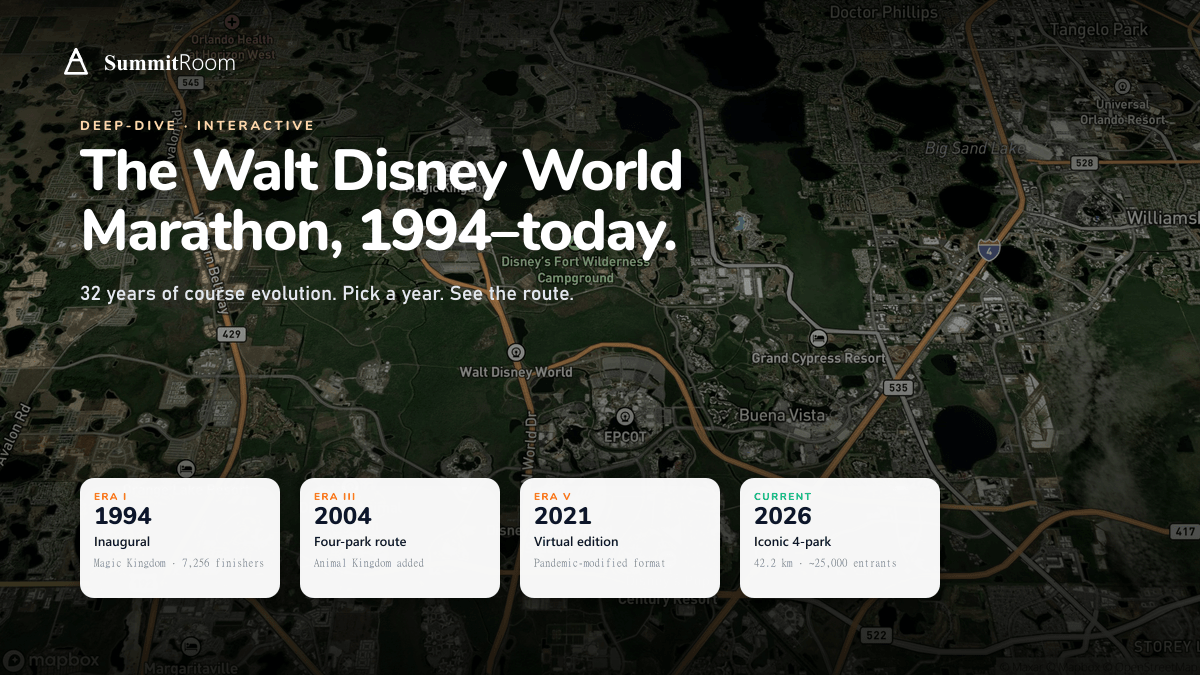
Use the era selector above to switch between them. Below is the prose version — what changed, why, and how the course evolved.
Era I · 1994 (Inaugural)
The first race was the simplest version of the route that's ever existed. Starting and finishing near Epcot, the course wound through Magic Kingdom (open for the runners only — characters in the windows, fireworks for the leaders), looped around Bay Lake, then returned via the Polynesian causeway and the Magic Kingdom service road back to Epcot.
Notable that year: the women's winner was Linda Somers (USA) in 2:37:52 — a time that would still be competitive in any Disney field today. The men's winner was Stan Cottrell (USA) in 2:25:14.
Era II · 1996–2003 (Two-park stabilisation)
By the late 90s the course had settled into a Magic Kingdom + Epcot route, often with detours through the Disney golf courses and resort areas. The race was now selling out months in advance and the Goofy Challenge (Disney's half + full back-to-back, debuted 2006 but conceived in this era) was on the drawing board.
The 5 a.m. start became the race's signature. Wave starts replaced the mass start in this period because character cosplay runners — Disney's quietly massive subculture of full-costume marathoners — were already causing congestion at the early gates.
Era III · 2004–2011 (Four parks)
Animal Kingdom opened in 1998. By 2004 the marathon course had been rerouted to thread through it — adding the iconic Tree of Life mid-race photo opportunity and stretching the runners' tour of property to all four major Disney theme parks for the first time.
Hollywood Studios (then "Disney–MGM Studios") followed soon after. By the late 2000s the race was firmly a 4-park tour, and the late-race overpasses between Hollywood Studios and Epcot — the ones that still hurt every runner today — became permanent course features.
Era IV · 2012–2019 (ESPN Wide World of Sports)
The course settled into its longest-running modern configuration during this period. ESPN Wide World of Sports Complex — Disney's mega-sports facility on the southern edge of property — was integrated as a mid-race detour between Animal Kingdom and Hollywood Studios. Runners enter ESPN around mile 17, run a loop through the baseball/soccer/basketball complex, then exit toward Hollywood Studios at mile 20.
This is the era where the marathon firmly became a destination event. International entries surged. The Disney Princess Half, Wine & Dine Half, and Star Wars races all launched in this period, with the January marathon as the flagship.
Era V · 2020–2022 (Pandemic disruption)
January 2020's race went off normally — just weeks before COVID-19 reached the US. January 2021's race went virtual. Runners completed 26.2 miles wherever they were (including, ironically, plenty on treadmills) and uploaded results to runDisney's portal for the medal.
The January 2022 race returned in-person but with reduced capacity, scaled-back expo, and a slightly shortened ESPN section. Costume rules were temporarily tightened (no face-masks-as-character-masks). The 2022 race had roughly half the field of a normal year.
Current · 2023+ (Modern iconic)
The course you'd run today is essentially the Era IV course, refined: the ESPN loop is slightly tighter, the Hollywood Studios transition smoother, the finish line at Epcot's World Showplace plaza. Field size is back to ~25,000 entrants across the marathon weekend. The 5 a.m. start, the corral system, the costume tradition, the character photo stops — all still defining features.
This is the course in our route library. The GPX you can download from /routes/disney is the 2026 official race file — 6,116 GPS waypoints with elevation on every one.
How we know all this
The historical narrative above is sourced from runDisney's own race archives, Mickey Miles Podcast historical episodes, and the WDW Magazine retrospective series.
What's next for the race
Disney has announced no major course changes for 2027 or 2028 at the time of writing. Field growth is the bigger story: marathon weekend now accommodates ~125,000 entrants across all distances (5K, 10K, half, full, Dopey Challenge, Goofy Challenge) — roughly twice the 2015 peak.
The likely future evolution is operational rather than geographic. Wave starts may expand from the current six to eight or more. Sustainability initiatives (single-use cup elimination, electric pace vehicles) are in early rollout. The course itself, having found its iconic shape in the 2010s, looks set to stay roughly as it is for another decade.